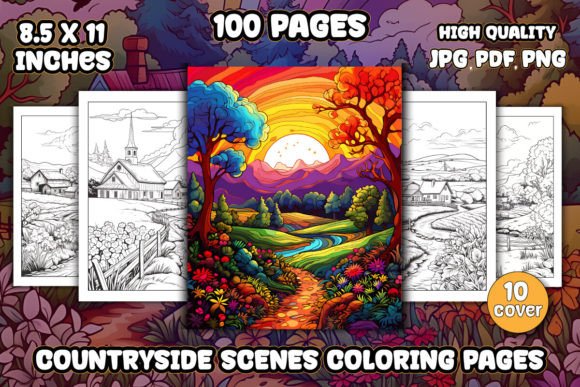
Countryside Scenes Coloring Pages: What to Check Before You Buy or Use Them
If you are looking into countryside scenes coloring pages for your KDP interior, POD products, or personal projects, you have likely noticed how many options exist. The appeal is obvious: rolling hills, quiet farmhouses, winding paths through meadows, and barns surrounded by autumn trees offer a calm, meditative experience for colorists. But not every set of pages delivers what it promises. Whether you are a creator, entrepreneur, or hobbyist, understanding what separates a useful collection from a disappointing one can save you time, money, and frustration.
This article walks through the practical details you should check before downloading or purchasing countryside scenes coloring pages, common mistakes people make when using them, and how to get the best results from your files.
What Countryside Scenes Coloring Pages Actually Include
A good collection of countryside scenes coloring pages typically contains a range of illustrations that capture rural life. You might find landscapes with fields and fences, farms with animals and barns, country cottages with gardens, or scenes with tractors and windmills. The best sets offer variety within the theme so users do not feel like they are coloring the same image repeatedly.
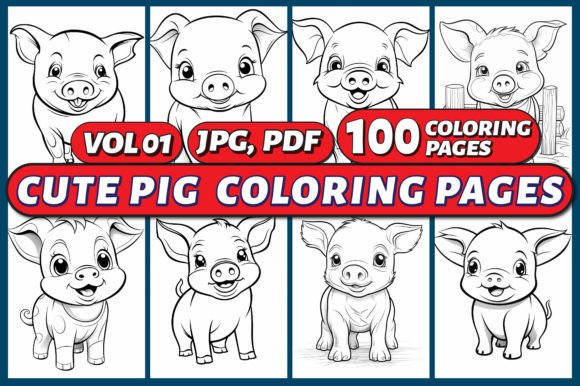
When you see a product described as having 100 high-quality files in JPG, PNG, and PDF formats at 300 DPI, that signals a well-prepared set. The A4 size at 8.5 by 11 inches is standard for print-on-demand and KDP interiors, so you can use the pages directly without resizing. Separate folders for each format make it easy to find what you need. Cover images included in the package are a bonus if you plan to publish on Amazon or sell on Etsy.
But here is where many people make their first mistake: they assume all files with these specifications are equal. They are not. The quality of the line art, the complexity of the designs, and the print readiness of the PDFs can vary considerably. You need to look deeper than the bullet points.
Overlooking the Actual Quality of the Line Art
One of the most common missteps is focusing on file format and DPI while ignoring the rendering of the drawings themselves. A countryside scene with thin, broken, or uneven lines will look poor when printed. Details that blur together or heavy lines that overpower the subject make coloring frustrating rather than relaxing.
When you evaluate countryside scenes coloring pages, look at sample pages closely. Ask yourself: Are the lines clean and consistent? Are the spaces large enough to color comfortably with markers, colored pencils, or gel pens? Do the illustrations include both simple and detailed areas so that beginners and experienced colorists both find value?
If you are buying from a marketplace, read reviews that mention print quality. If you are creating your own set using AI-generated designs, check each image before including it. AI can produce impressive results, but it also sometimes creates artifacts, awkward shapes, or lines that do not connect properly. A quick review of every page prevents you from delivering a product that frustrates your customers.
Assuming All File Formats Are Equally Useful
Another oversight is treating JPG, PNG, and PDF as interchangeable. They serve different purposes, and knowing the differences helps you use the set effectively.
- JPG files are smaller in size but use lossy compression. They work well for previews, thumbnails, and cover images, but printing from a JPG can sometimes introduce compression artifacts, especially if the file has been saved multiple times.
- PNG files preserve transparency and sharp edges. They are ideal if you want to place a design on a colored background or combine elements in a graphics program. For coloring pages, PNGs with no background mean you can print them on different paper colors.
- PDF files are the standard for print-ready documents. A well-made PDF maintains vector-like sharpness and ensures that every page prints exactly as intended. For KDP interiors, PDF is usually the format you will upload.
A set that provides all three formats in separate folders gives you flexibility. You can use the PDF for printing, the PNG for digital manipulation, and the JPG for quick previews. If a seller skimps on formats, you lose that flexibility. If you are assembling your own collection, save each version so you can offer the same convenience to customers.
Ignoring Print Readiness and Bleed Requirements
Print readiness is more than just 300 DPI. It includes proper margins, no missing content near the edges, and correct page size. For KDP, a common mistake is uploading files that do not account for bleed. If your countryside scenes coloring pages have elements that extend to the edge of the page, you need a bleed area of at least 0.125 inches on each side. Without it, trimming can cut off part of the illustration.
Check whether the PDF files in your set are truly print-ready. Open a page and look at the margins. Is there a white border around the illustration? Is the artwork centered? If the files were designed without bleed considerations, you may need to add margins yourself or risk rejected uploads.
For POD products like spiral-bound books or saddle-stitched booklets, the paper weight and binding type also matter. Heavy coloring pages printed on thin paper will bleed through. If you are selling physical books, pair your coloring pages with the right paper stock and test a proof before listing.
Misunderstanding What AI-Generated Means in Practice
The product description you see states: "Note: This is AI generated coloring pages. But this image quality is very good." That is an honest disclosure, and it should prompt you to examine the images carefully rather than dismiss them.
AI-generated coloring pages can be excellent when the prompts are well crafted and the files are curated. However, some creators generate hundreds of images at once and include every result without filtering. This leads to designs where:
- Fences have missing rails or oddly shaped posts
- Animals have extra legs or distorted features
- Perspective makes barns look tilted or floating
- Tree branches connect in physically impossible ways
These issues might go unnoticed in a thumbnail but become obvious when someone tries to color a section. A farmer's fence that looks broken on the page stops being relaxing and starts being annoying. The solution is to inspect each page. If you see a design that looks off, either edit it or leave it out. Your reputation as a seller depends on the quality of every page in your book.
On the buyer side, look for sample pages that show the actual line art. If the seller only shows a cover or a single page, ask for more examples. A good set will have consistent, readable designs throughout.
Choosing Images That Do Not Match Your Audience
Countryside scenes appeal to a broad range of people, but not every illustration suits every colorist. Beginners often prefer larger spaces and simpler lines. Experienced colorists might want intricate details like thatched roofs, stone walls, or fields of wildflowers. Children need bold, simple shapes without tiny sections that are hard to stay inside.
A common mistake is buying a set that leans too heavily in one direction. If you are selling on KDP, you want your coloring book to target a specific audience. A book labeled "for adults" should not contain cartoonish barns with oversized doors unless that is the stated style. Conversely, a book for children should not have tiny branches and distant hills that are nearly impossible to color without frustration.
Know who you are designing for or buying for. If you are a creator, mix simple and complex designs so that the book has range. If you are a buyer, check the sample pages to see whether the level of detail matches your preference or your customers' expectations.
Neglecting the Cover and Presentation
The internal pages matter most, but the cover is what gets people to open the book. A set that includes 10 high-quality cover images is a sign that the seller understands presentation. Use one of those covers, or design your own, but do not rush this step. A cover that looks generic, has low-resolution art, or does not convey the calming nature of countryside scenes will hurt your sales.
Good covers for coloring books typically show a colored version of an interior page or a composite scene that hints at the kind of illustrations inside. The title should be readable at thumbnail size. Avoid cluttering the cover with too much text or too many fonts.
If you are using the coloring pages for personal projects or classroom materials, you might not need a polished cover. But for any commercial use, investing in a professional-looking cover is one of the most effective things you can do to improve results.
Forgetting to Test Print Before Selling or Sharing
This is perhaps the most avoidable mistake. Even when everything looks correct on screen, printed results can surprise you. Lines that appeared thin on a monitor may print much lighter. Details that seemed clear may become muddy. Colors in a JPG preview might shift when converted to PDF.
Print one or two pages from the set before you upload to KDP or send files to a POD service. Use the same printer and paper you plan to use for the final product. Check that the page size is correct, that the design sits properly on the page, and that the lines reproduce cleanly. If the printed page looks good, you can be confident the rest will too.
This step also helps you catch any page-numbering issues, accidentally duplicated images, or files that did not export correctly. A single test print can save you from a batch of returns or negative reviews.
What to Do Next with Your Countryside Scenes Coloring Pages
If you are preparing a KDP interior, start by organizing your files from the separate folders. Use the PDF versions for your upload. Write a short introduction page that sets the tone for relaxation and creativity. Add a "This book belongs to" page if you want a personal touch. Then test a proof copy before making your listing live.
If you are using the pages for POD products like mugs, tote bags, or wall art, the PNG files with transparency will be your best option. They let you overlay the design on different backgrounds without white boxes around the image.
If you are a hobbyist who simply wants to color for relaxation, print the pages on good quality paper and keep a set organized in a binder. Use the variety of scenes to match your mood: simple landscapes when you want to unwind, detailed farm scenes when you want to focus.
Countryside scenes coloring pages can be a genuine source of calm and creativity when you choose the right set and use it thoughtfully. The quality is in the details, not just the description. Take the time to evaluate what you are getting, test before you commit, and match the designs to your real needs. That approach will serve you well whether you are selling, creating, or simply coloring for your own enjoyment.