Mushroom Coloring Pages for KDP: What Most Sellers Get Wrong and How to Fix It
If you have spent any time exploring Amazon KDP, you have likely noticed the steady demand for nature-themed coloring books. Among them, mushroom coloring pages have become a quiet favorite. Adults enjoy the intricate patterns, the organic shapes, and the calming effect of coloring fungi in forest settings. Yet many sellers jump into this niche without understanding what separates a profitable interior from one that collects dust. The difference is rarely about talent. It is almost always about knowing where the hidden pitfalls lie.
Why Mushroom Coloring Pages Attract a Wide Audience
Mushrooms appeal to more than just botanists or nature lovers. They attract mindfulness practitioners who use coloring as a form of meditation. They draw in fantasy fans who appreciate the whimsical, almost magical appearance of fungi. They also appeal to adults who simply want a relaxing activity that does not require screens or complex instructions. The market is broad, but the competition is real. Many sellers produce pages that look decent at first glance but fail to deliver the quality that buyers actually expect.
The mistake many newcomers make is assuming that any collection of mushroom outlines will sell. Buyers on Amazon have become discerning. They compare resolution, page count, cover design, and print readiness before clicking purchase. If your product looks rushed or recycled, they move on. Understanding what makes a set of mushroom coloring pages truly usable is the first step toward building a reliable KDP product.
Overlooking Resolution and Print Quality
The most common error I see involves resolution. Sellers grab images from sources that claim high quality, but when printed, the lines appear fuzzy or the details blur. A mushroom coloring page with delicate gills, stems, and surrounding foliage needs sharp definition. If the resolution is below 300 DPI, the printed result will disappoint customers who expect crisp lines for fine-tipped markers or colored pencils.
A practical habit to adopt is checking every file before you upload. Open each image at 100% zoom and look at the edges. If you see pixelation or softness around the lines, that page will not hold up on paper. The folder structure you receive should clearly separate JPG, PNG, and PDF files so you can test each format. The JPG files give you a quick preview, but the PDF files are what your customer will likely use for printing. Make sure those PDFs render cleanly.
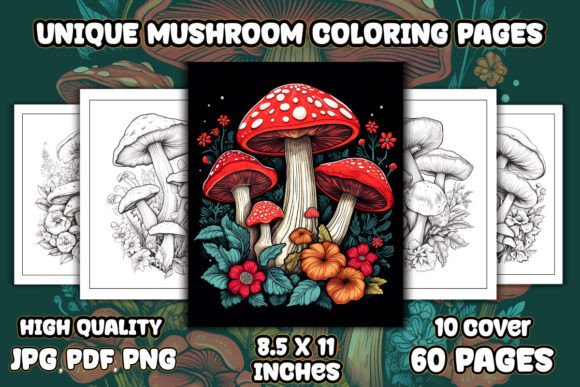
When you evaluate a set like this one, you want to see that the 60 images are uniformly sharp. Any variation in line weight or clarity suggests that some pages were generated or processed differently. Consistency across all pages is what builds trust with your audience.
Ignoring the Cover and First Impression
Another oversight happens before the customer even opens the book. The cover image is your only chance to grab attention in a crowded search result. Many sellers treat the cover as an afterthought, using a generic mushroom photo or a low-effort graphic. That approach signals to the buyer that the interior may also lack care.
Having ten high-quality cover images included in your asset pack is a major advantage. It allows you to test different styles and see which resonates with your target audience. Some buyers prefer realistic mushrooms with earthy tones. Others are drawn to whimsical, almost fairy-tale depictions. You can rotate covers for different listings or use them to create separate books for different moods. Do not settle for a single cover when you have options that can help you stand out.
When designing your cover, ensure that the title is easy to read at thumbnail size. Many shoppers browse on mobile devices. If they cannot tell what your book is about within two seconds, they will scroll past. A clear, attractive cover that hints at the intricate interiors will give you a better click-through rate.
Underestimating the Value of File Format Choices
Let me address a detail that many sellers overlook: not all file formats are equal for every use case. If you plan to sell on Amazon KDP, the PDF format is your primary concern because that is what gets uploaded for print-on-demand. But if you also intend to offer digital downloads or use these pages for POD products like mugs, tote bags, or journals, you need the JPG and PNG files to be equally high quality.
I have seen sellers purchase a set of coloring pages only to discover that the JPGs are compressed or the PNGs lack transparency around the lines. That limits what you can do with the designs. The set you choose should include separate folders for each format so you can grab exactly what you need without converting files and losing quality. A well-organized ZIP file with 60 JPG, 60 PNG, and 60 PDF files, plus covers, is the gold standard. It gives you flexibility across multiple platforms and products.
Misunderstanding the Role of AI-Generated Art
There is still confusion around AI-generated coloring pages. Some buyers are skeptical, and some sellers worry about quality. The truth is that AI can produce exceptionally detailed and usable images, but only if the generation process is carefully managed. The key phrase to remember is consistency and curation.
If you use AI-generated pages, you need to review each one. Not every output will be print-ready. You may find pages where lines do not connect properly, where the design is too cluttered to color comfortably, or where the subject matter feels repetitive. The set I am referring to has been curated so that all 60 pages maintain a high standard. That curation is what separates a usable product from a frustrating one.
When you present AI-generated pages to customers, you are not obligated to hide that fact. What matters is the final experience. If the lines are clear, the designs are engaging, and the paper size is standard A4 or 8.5x11, most customers will be satisfied. Focus on the result, not the method.
Neglecting Practical Testing Before Launch
Before you upload your mushroom coloring book to KDP, print a few pages yourself. It sounds obvious, but many sellers skip this step. You want to see how the lines look on paper. You want to test if the white space allows for shading or background additions. You want to confirm that the 300 DPI claim holds up in real life.
Print one page at actual size. Color it with markers, pencils, or whatever tools your target audience might use. Does the paper bleed through? Are the lines too thin for someone with less steady hands? Are the details too intricate for a beginner? These are questions that testing answers. If you cannot answer them, your product description will lack the specificity that builds confidence.
Also, check the PDF file for any formatting issues. Sometimes margins shift during export, or page numbers appear where they should not. A clean, print-ready PDF should open exactly as intended, with no surprises. The folder labeled "PDF file Print ready" should contain files that you would be happy to hand to a paying customer.
Overcomplicating the Interiors
Another pattern I notice is sellers trying to pack too many elements into a single page. Mushroom coloring pages work best when the design has a clear focal point and enough negative space to allow coloring without feeling cramped. A page that is overly dense with tiny mushrooms, leaves, and background patterns can overwhelm the user. While some adults enjoy extreme detail, most prefer a balanced composition that lets them finish a page in one sitting.
Stick to designs that feature one or two main mushrooms with complementary elements like grass, vines, or small forest details. The 60 pages in a quality set should offer variety without chaos. Some pages should have large, bold shapes for beginners or those who want a faster activity. Others should include finer lines for experienced colorists. That range keeps your book accessible to a wider audience.
Ignoring the Dimensions and Standard Formats
Amazon KDP prefers specific dimensions, and the standard 8.5 x 11 inch size is the most versatile for coloring books. It fits standard printers, it works with common paper sizes, and it gives enough room for detailed designs. When you purchase a set that already conforms to 8.5 x 11 inches, you save yourself the hassle of resizing every page.
Resizing images can distort line art. Even a small change in aspect ratio can make a design look stretched or compressed. If you must resize, do so proportionally and check the results. But the easier path is to start with files that are already at the correct dimensions. This set was designed with that size in mind, which means you can drop the files directly into your KDP dashboard without adjustments.
Practical Advice for Making Your Mushroom Coloring Book Stand Out
If you want to build a sustainable KDP business with mushroom coloring pages, focus on three things: quality control, customer expectations, and product consistency. Do not assume that more pages always means more value. A 60-page book with thoughtfully designed interiors will outperform a 100-page book filled with filler content. Buyers can tell when pages are duplicated or when the quality drops halfway through.
Write a product description that honestly reflects what is inside. Mention the resolution, the number of pages, the paper size, and the variety of designs. If you have tested the pages and know they work well with colored pencils, say so. If the designs range from simple to complex, mention that too. Customers appreciate transparency because it helps them decide with confidence.
Finally, remember that your cover is a promise. If your cover shows a detailed, beautiful mushroom illustration, the interiors should match that standard. Inconsistency between cover and content leads to returns and negative reviews. The ten cover images included in this set give you room to create a cover that accurately represents the 60 pages inside. Use them wisely.
Mushroom coloring pages offer a genuine opportunity in the KDP space, but the difference between a successful listing and an ignored one comes down to the details you check before you publish. Resolution, format, consistency, and honest presentation will always outperform shortcuts. Take the time to evaluate your assets, test your files, and present your book with care. Your customers will appreciate it, and your results will follow.