Unicorn Portrait Coloring Pages for Adults: A Practical Guide to Creating KDP Interiors That Sell
Creating a successful low-content or medium-content book for Amazon KDP requires more than just assembling random images. You need a cohesive product that delivers a specific experience to your buyer. A collection of Unicorn Portrait Coloring Pages for Adults offers exactly that—a focused, high-quality interior that appeals to a niche audience looking for stress relief, creative expression, or simply a beautiful pastime. This article walks through what this resource is, how to integrate it into your publishing workflow, and how to get the most out of every page.
What Unicorn Portrait Coloring Pages for Adults Actually Provides
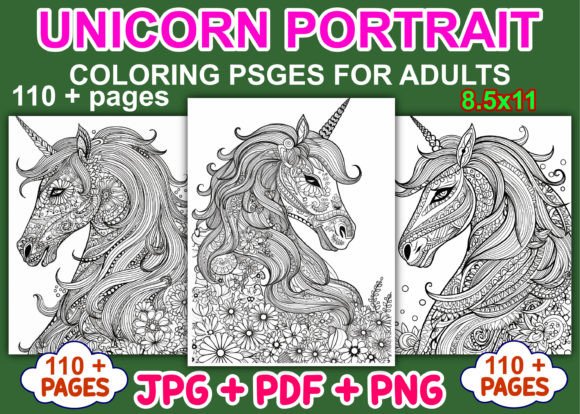
At its core, this is a curated set of 114 coloring page designs, all built around the unicorn portrait theme. Each image is delivered at 300 DPI in vertical (portrait) orientation, sized to fit standard A4 and 8.5×11-inch paper. You receive the files in three formats: PDF (print-ready), PNG, and JPG. That means you have immediate flexibility whether you are working in design software like Canva, Adobe InDesign, Affinity Publisher, or even a simpler tool like Microsoft Word.
The term “unicorn portrait” matters. Instead of generic fantasy scenes, each page focuses on a detailed, face-forward or bust-style unicorn illustration. This gives the book a consistent visual identity. For the adult colorist, portraits offer a satisfying level of detail—manes, horns, facial features, and decorative elements—without overwhelming the page. For you as the publisher, consistency across pages makes assembly faster and reduces the need for heavy editing or reformatting.
Where This Fits in Your Content Creation Workflow
Understanding where a resource fits in your broader process is half the battle. A collection like this works best during the asset assembly phase of your book creation. You have already decided on your niche (unicorn portraits for adults) and your trim size (8.5×11 or A4). Now you need the raw materials.
Instead of spending hours or days designing individual pages from scratch, you import these ready-made files directly into your layout. This shifts your focus from creation to curation and arrangement. You decide the order, add front and back matter, check for bleed and margin consistency, and export the final PDF. The heavy creative lift is already done by the designer who built the 114 pages.
This resource also fits well after you have validated your niche. Maybe you have already sold a few general coloring books and want to expand into more specific themes. Unicorn portrait pages let you test a sub-niche without commissioning custom artwork upfront. And if you are building a series, these pages become one volume in a larger catalog—volume one could be unicorn portraits, volume two could be magical creatures, and volume three could be fantasy landscapes. The consistent format (200 DPI, same trim size, same page count) makes bundling and republishing straightforward.
Preparing Your Files: What to Do Before You Start Arranging
You have the three formats: PDF, PNG, and JPG. Each serves a slightly different purpose in your workflow.
- PDF (print-ready): This is your fastest path to a completed interior. If the pages are already laid out correctly with proper bleed and margins, you can often use this file as-is, adding only your front matter and cover. Always open a few pages to verify alignment.
- PNG (transparent background): Useful if you want to overlay the unicorn illustration on a colored background or add decorative elements behind the image. PNGs also preserve crisp edges, which matters when you are working with detailed line art.
- JPG (white background): The most straightforward format for drag-and-drop placement. Works well in any software and keeps file sizes manageable. Good for quick assembly when you don’t need transparency.
Practical tip: Before you import all 114 pages, open a representative sample—say, the first page, a middle page, and the last page—in your design software. Check that the resolution is uniform, that the artwork sits within safe margins, and that the grayscale or line art values are consistent. A quick quality check at this stage prevents printing surprises later.
Integrating the Pages into a Complete Book Interior
A great set of coloring pages still needs structure to become a professional book. Think of the 114 unicorn portraits as the core content. Around that core, you need:
- A title page that matches your cover design and sets the tone.
- A copyright page with your publication details and rights notice.
- A brief introductory page (optional) that speaks to the adult colorist—a few words about relaxing, using colored pencils or markers, or the joy of fantasy art.
- A blank page or a test page where users can try a color palette before committing to a full portrait.
- A back page with your brand or website, encouraging readers to leave a review or check out other books in your series.
Then you insert the unicorn portrait pages in the order you prefer. Some publishers arrange them by complexity from simple to detailed. Others group similar mane styles or horn designs together. There is no right answer, but consistency matters: if you group by style, keep that grouping throughout. If you randomize, randomize the whole set. Avoid switching halfway through.
Because you have 114 pages, you might also consider adding a few blank pages at the end for free drawing or note-taking. This adds perceived value without requiring additional artwork and gives the user more ways to engage with the book.
Workflow for Assembling Your KDP-Ready Interior
Here is a straightforward, repeatable workflow that uses the unicorn portrait files efficiently.
- Set up your document. Create a new file at 8.5×11 inches (or A4) with 0.125-inch bleed on all sides. Set your margins to at least 0.5 inches to keep the artwork safe from the binding.
- Import front matter. Place your title page, copyright page, and introductory page. Keep these pages minimal so the focus stays on the coloring content.
- Import the coloring pages. Drag your PNG or JPG files into the document, one per page. Center each image within the safe margin area. If you are using the PDF, you can often copy-paste pages directly.
- Check page order. Scroll through the entire 114-page sequence. Look for any duplicate pages, upside-down images, or spacing issues. Make adjustments as needed.
- Add page numbers (optional). Some adult coloring books include page numbers; others skip them to keep the pages clean. If you add numbers, place them at the bottom center or outer corner.
- Export to PDF. Use the “Press Quality” or “High Quality Print” preset. Ensure all fonts are embedded and that your PDF complies with KDP’s specifications (PDF/X-1a or PDF/X-4 are solid choices).
- Upload and preview. Use Amazon’s Kindle Create Previewer or the KDP preview tool to check how your interior looks page by page. Flip through the entire book before publishing.
This entire workflow, once you are familiar with the files, should take a few hours for the first book. After that, you can replicate the process with other volumes in minutes, especially if you save a template.
Quality Control and Consistency Checks
Even with a pre-made resource, you are the publisher and quality is your responsibility. Here are specific checks to run before hitting publish.
- Resolution: Confirm all pages are at 300 DPI. If you resize an image in your layout software, make sure you are scaling down rather than up. Upscaling a low-res image creates blurry lines.
- Line weight: Unicorn portraits with very thin lines may not print well, especially if you use standard paper. If any pages have extremely delicate details, consider testing a print sample first.
- Bleed: Any element that extends to the edge of the page must reach into the 0.125-inch bleed area. Check that your images are placed correctly and not leaving white gaps along the edge.
- Gutter margin: For books over 100 pages, the binding curve can hide content near the spine. Keep critical parts of each unicorn portrait at least 0.5 inches away from the inner edge.
- File size: A 114-page book with high-res images can become large. Upload limits for KDP are about 650 MB for black-and-white interiors, but keeping your file under 200 MB helps with faster uploads and fewer errors.
One practical approach: print a physical proof of the first five pages and the last five pages using a home printer or a local print shop. Seeing the line art on actual paper reveals issues that a screen preview never shows.
Long-Term Use and Repurposing Strategies
The true value of a resource like Unicorn Portrait Coloring Pages for Adults extends beyond a single book. Because you own the commercial rights (the description states you can use the images for everything you want), you have several options for long-term use.
- Volume series: Publish multiple books using the same set of pages but arranged differently. For example, “Unicorn Portraits: Majestic Manes” could feature 40 pages, while “Unicorn Portraits: Enchanted Horns” features another 40. You can split the 114 images into multiple smaller books.
- Bundles: Combine this interior with a matching cover and sell the entire package to other publishers on platforms like Creative Market or Etsy. Many KDP publishers buy ready-made interiors.
- Print-on-demand merchandise: Use individual unicorn portraits on mugs, puzzles, calendars, or greeting cards. The 300 DPI resolution supports these formats well.
- Digital downloads: Offer single-page downloads or smaller packs on Gumroad, Etsy, or your own website. Some customers prefer to print only the pages they like.
- Lead magnets: Give away a small sample (5–10 pages) as a free download to build your email list or drive traffic to your KDP catalog.
Each of these uses leverages the same core asset without requiring new design work. Your initial purchase becomes a reusable inventory item for multiple revenue streams.
Practical Observations for a Smooth Experience
Working with a large set of files (114 images in three formats) means you need a solid file management system. Here are some observations from real publishing workflows.
- Rename files if needed. If the provided filenames are sequential (e.g., “001.png,” “002.png”), they should import in order. If they are named arbitrarily, sort them in your file explorer before importing.
- Use batch processing. If you need to adjust brightness, contrast, or sharpness across all images, use a tool like Adobe Bridge, IrfanView, or a simple script in Photoshop. Doing this one by one for 114 images wastes time.
- Keep master copies. Store the original ZIP or folder of files in a safe location. Never work directly from the original set. Copy the folder and work from the copy, so you always have a clean backup.
- Test print a single page early in the process. Pick a representative portrait and print it at full size. Check that the lines are crisp, the page margins work, and the overall look matches your expectations.
Publishing a coloring book with 114 pages is a manageable project when you break it down into preparation, assembly, quality control, and publishing. The unicorn portrait theme appeals to a dedicated adult audience, and the high-resolution files give you professional-grade output on every print.
Whether you are assembling your first KDP interior or adding another title to an established catalog, this resource provides the foundation. Your job is to package it well, check the details, and get it in front of the right buyers. With a clean workflow and attention to consistency, you can turn these 114 pages into a product that looks polished, sells steadily, and builds momentum for your brand.